Showing posts with label museums. Show all posts

Sunday, February 15, 2009

A serious art museum in Austin? Blanton's permanent collection improving with Latin American additions

Kathy and I went to UT-Austin's Blanton Museum of Art yesterday afternoon, and they've improved their collection a lot since I'd been there last.

A commissioned work covering the walls and stairs at the main entrance - tiles resembling stacked water in rolling waves of blue - really improved the visitors' first impression. And at the top of the stairs leading to the main galleries, they've installed a gorgeous African piece made of metal strips from Nigerian liquor bottles sewn together with copper wire to look (from a distance) like a woven blanket with tribal patterns. Very cool, and a step forward from the European dominated pieces that formed the base of their initial collection.

They're developing a significant Latin American base for their permanent collection - a decision which, as a lover of Mexican art, I can only applaud. Among the new pieces acquired since I last visited was a small painting by David Siquieros, the Mexican painter who once tried to assassinate Leon Trotsky. I didn't know previously that Siquieros was a mentor of Jackson Pollock. You could see from the painting they'd chosen how Pollock's "controlled accidents" may have evolved in part from Siquieros' stylings, though I'm not sure I'd have otherwise made the connection.

An acquisition fund left to the museum by writer James Michener has been used to purchase a number of excellent new pieces from Latin America and elsewhere, including the piece pictured above by Jerry Bywaters, a former Dallas Morning News art critic and co-founder of the Dallas Nine, a group of artists who became known when they (unsuccessfully) tried to get permission to decorate the interior of the Hall of State on the state fair grounds during Texas' centennial celebrations.

I think that's exactly the direction they should take the museum's collection, fulfilling a niche that to my knowledge nobody else has taken. I'm not aware of a serious, permanent collection of Latin American art on US soil, certainly not in Texas, and there's a lot of wonderful historical and artistic ground to cover. Let somebody else do ancient Greece and the European masters.

That said, the European art in the Blanton is certainly impressive, just not in any way unique. I've got a fascination with religious history so I especially appreciate the Christian art from the 15th and 16th century they've compiled, which includes some beautiful pieces. A series of drawings featured in a collection of art from the era of Pope Clement included sketches for larger murals and elaborate drawings of action scenes commissioned for an international Jubilee in 1600. The most vivid of these (and there were several) depicted attacks on soldiers by wild lions. They were beautiful to look at, but quite classical not particularly interesting, as art exhibits go. If you visit big museums with any frequency, you've seen much like it before.

When the Blanton first opened, I was particularly unimpressed with their collection. But by my third visit yesterday, their team of curators had bolstered that initial batch of art with numerous quality additions, giving me hope that, before long, Austin may actually have a serious, quality museum with exhibitions rivaling those in Houston and Fort Worth.

As an aside, by comparison to the ever-improving Blanton, the Bob Bullock Texas History Museum across the street, by all accounts, remains a complete mess - if they didn't have an IMAX theater, I can't imagine why anyone would go there.

That's a source of embarrassment to me because I care a lot about Texas history and think there's much of significance besides nostalgia and schlock for them to present, but that would require more serious and creative curation. Perhaps as the Blanton's collection improves, with a serious museum across the street the Texas History Museum will ultimately be shamed into presenting a more serious collection.

Friday, December 28, 2007

Fort Worth museum exhibit boasts earliest Christian art

Before Christmas Kathy and I visited this exhibit on early Christian art at the Kimbell Art Museum in Fort Worth - described here by the San Antonio Express News - "Picturing the Bible." It was a neat experience I'd highly recommend if you get the chance; the exhibit continues through March 30, 2008.

Nearly all truly ancient Christian art - even after the Roman Emperor Constantine converted to Christianity in the Fourth Century - has been destroyed as a result of later "Iconoclastic" movements bent on destroying images that portrayed the Divine or even humans since they were created in God's image. Countless ancient works were lost to these awful movements, whose motivations mirror those of radical Islamists today who object to portrayals of Muhammad.

We'd gotten to see some of the early Christian art that escaped the Iconoclasts when we were in Turkey, buried in underground temples and chapels carved from caves out of canyons in Cappadocia that to this day one must hike in to see. Many of these drawings in what today is central Turkey (and what in ancient times was "Galatia," as in Paul's epistle to the Galations) were done by monks loyal to St. Gregory, the earliest Christian monastic, who led his followers into the wilderness in central Asia Minor to contemplate God in true, remote isolation. (Some of these images were preserved because they'd become covered with smoke over time, and are only now being restored, often revealing brilliant color preserved by the ash, virtually untouched in more than a millenium.

In Fort Worth, though I got to see even older specimens, the most ancient from the catacombs around Rome excavated around the turn of the 19th Century. The paintings on these catacombs dated, at the earliest, from around 200 A.D., and constitute the oldest extant Christian art, nearly one hundred years older (and much more classically Grecian in style) than anything I'd seen before.

Discovered in the 19th Century outside of Rome, the Vatican commissioned what are known as the Wilpert Watercolors, named after Josef Wilpert (1857-1944), a photographer who took more than 600 photos of the ancient tombs and Christian paintings and sculpture inside, in many cases documenting art that was untouched since the graves were closed. The photos were in black and white, but we're incredibly lucky (since much of the art didn't survive excavation) that Vatican scholars had the foresight to commission artist Carlo Tabanelli to take the same photos into the catacombs and paint over them in watercolor to document the exact colors in the original tombs. The result is a 600 page book that must be out of print (I can't find it available online, but we copied the title from the exhibit), called Roma Sotteranea: Le pitture delle catacombe romane.

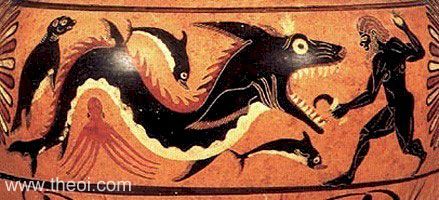
By far the most common themes from the catacomb art were the Good Shepherd and his flock, Adam and Eve (see the finely detailed ring in the first image above), Noah's Ark and Family, and the story of Jonah and the "great fish," which the ancients saw as directly foreshadowing Christ's resurrection (Jonah three days in the fish; Christ three days in the tomb). Interestingly, unlike today when we think of Jonah in the belly of the whale, ancient Christians believed Jonah had been swallowed by a Keto (at left), or a Grecian sea monster straight out of the Homer and the Odyssey. This early mixing of pagan Greek and Christian symbology was especially striking in light of how our conception of the story of Jonah has changed thanks to modern science and sea exploration.

The Kimbell has hosted some great exhibitions of religious art in recent years, including an exhibit Kathy and I saw in 2003 featuring mediaeval "illuminated manuscripts," and another in 2005 featuring Islamic art (which of course we also saw plenty of in Turkey). I was glad to get to see these excellent pieces, from which I learned quite a bit. Topping the visit off with a walk in the Botanical Gardens (a beautiful, Depression era WPA project) and dinner at the always excellent Realta restaurant downtown, I found the two-day sojourn to Fort Worth last week an enjoyable jaunt, well worth the trek.