Showing posts with label electronics. Show all posts

Sunday, December 27, 2015

9-year old solders TV-B-Gone kit


Completed Adafruit TV-B-Gone kit
I'm a proud grandpa today. The granddaughter did her most ambitious soldering project yet - a TV-B-Gone from Adafruit (see here, really it's cool) - which totals out at about 60 solders or so and took her 2 hours, with reading the instructions being the most time consuming part. She even had a couple of screwups she had to fix with the solder sucker, a task she performed without getting frustrated or giving up. For a nine-year old, I thought it was a pretty impressive feat of concentration. She placed every component and soldered all of it herself; she defiantly didn't want any more grownup assistance than absolutely necessary.

At one point I asked if she needed help. She replied exasperatedly, "I'm fine Grandpa, I've been doing this for a long time." And the funny thing is, she has - right about two years, anyway.

When we finished, we tested the device in my bedroom and the TV dutifully turned off. She screamed as though she were a 1961 teenybopper at a Beatles concert and danced and bounced on the bed in full, spasmodic ecstasy for nearly a full minute before we could calm her down. She wanted to share her achievement with my nonagenarian in-laws, who just moved in across the street a week or so ago, before taking it back to her mother, for whom she made it as a gift. Now that she sees it works, though, I think she kind of wants to keep it.

Or maybe we'll just have to make another one.

Sunday, November 02, 2014

Next up on an 8 year old's soldering kit tour: Snap-o-Lantern (Updated)

The young'un received a "Snap-O-Lantern" kit from her Spark Club mentors at The Thinkery too late for us to put together at home by Halloween. But I think it'll make a great Thanksgiving centerpiece (one that can sit around most of the day and get swept aside when the turkey, etc., is ready). From the "Evil Mad Scientist" site that produced the kit: "Normally, it just sits there, in disguise as a boring old pumpkin."


"But, every twenty seconds he comes to life. His LED eyes turn on, his jaw slowly opens, and then SNAPS shut– and he goes back into stealth mode."


With a (much) bigger servo and a bit of creative pumpkin engineering you can take the concept to extremes. I'm wondering if there's some way to trigger the thing with a sensor of some sort, especially if after the holiday is over and the squash has gone bad we wanted to do something like this with it. I rather like the idea of a book that peeks up  at you with glowing eyes, but I'd like it better if it reacted to, say, someone sitting down in a designated chair, reacting to either a motion or a pressure sensor. (Ditto for the pumpkin gimmick, for that matter.)

The project is definitely within Ty's soldering/technical skills, but the use of an actual squash means we must do it relatively soon before Thanksgiving - perhaps the weekend before, at the earliest - to keep it from becoming fly infested. Using the same apparatus for the peek-a-boo book has more long-term potential, but making it sensor driven would boost the fun. Will report back if I figure out how.

UPDATE (12/16): I hope it's true we learn more from our failures than our successes because this was our first failure together, and more mine than hers. This was her most complicated soldering project to date. Because we'd gotten this from her children's museum class, I only had one and didn't put one together myself before she tried to do it. I wish I had. Every moment of indecisiveness before figuring out where to put a piece made her more frustrated (and at eight her reading comprehension wasn't quite up to the instructions, which we were reading off a lap top at the dining room table/work station, so much of it was inevitably on me). Finally, jerking away to conceal what she was doing in some ill-conceived expression of a privacy demand, Ty splattered solder just about everywhere including across more than a dozen connections on the circuit board and in and around all the chip connections. I attributed this behavior to my own unpreparedness and lack of pedagogical skills, regrettably; I understand why she was frustrated. The front end of a learning curve isn't always fun. And if my own skills were better, I'd be a better teacher. Regardless, no amount of solder sucking and wicking was able to salvage it, though I did save the motor and large orange leds for another day.

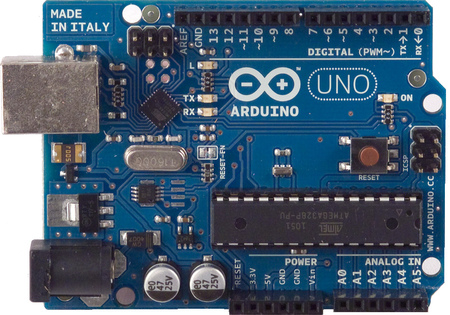
Contemplating my abysmal pedagogical failure, I came to this head slapping realization: We only took to soldering this kit because it was handed to her at her Spark Club class at the Thinkery, Austin's big children museum. But if I'd given it two thoughts, this project would be easy to put together with little or no soldering by using an Arduino, a breadboard and jumper wires. I'm going to try it first without her over the Christmas holiday. Perhaps I can get her interested in a less fussy project involving less soldering, against which she's started to push back once we reached these slightly more complicated projects.

Saturday, January 25, 2014

Beware the WeevilEye: Soldering for 7-year olds

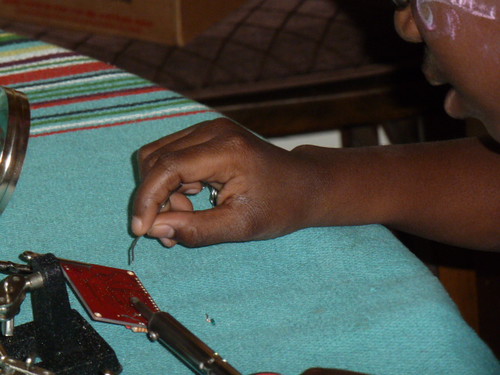
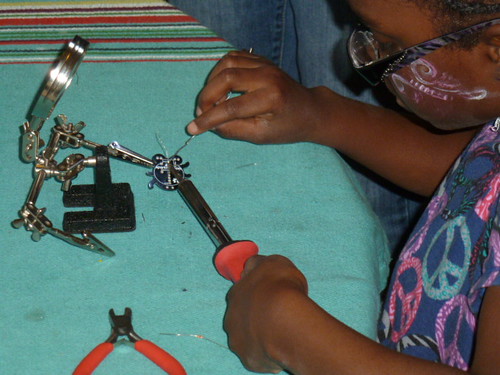
For Christmas, the granddaughter received a "WeevilEye" soldering kit we got her from SparkFun. Last week she soldered together an LED circuit she and Grandma made into a bracelet with moldable plastic, but this was a much more involved, detailed affair, and the first time she'd soldered onto a printed circuit board (PCB). So we had her practice first on a scrap board, soldering several wires and a resistor:


Once she had that process down, she started in on the WeevilEye.


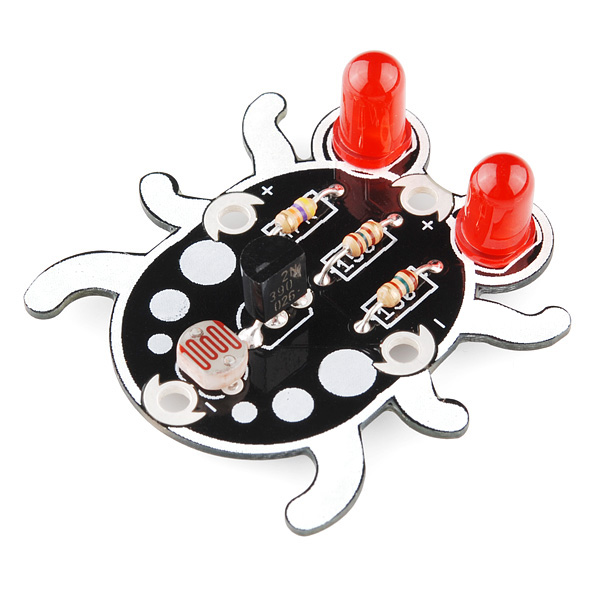
Three resistors, a transistor, a light sensor, two LEDs, and a battery holder later, the finished project worked just as advertised: The eyes light up when it's dark and go off in the light.


The only real problem came when some solder bled across both slots on one of the LEDs, but that was fixed just by reheating it and wiping off the excess with a small sponge. Also, the coin cell battery holder leads were a bit small and difficult to access once all the other components were in, but she accomplished it just fine once she found the right angle. Here's what the finished product looked like, from the SparkFun site:
If I had one suggestion it would have been for the manufacturers to include an on-off switch on the battery holder. Because it uses a transistor, the device drains the battery even when the LEDs are off. But the battery pops out pretty easily and that's not a big problem. Quite a nice little introductory soldering kit for a seven-year old.

AND MORE (Feb. 12): Not a soldering project but I wanted to store these links somewhere: Last weekend we took the young'un to an event at Laguna Gloria Art Museum in Austin where they had the kids create small theremins on a breadboard. Excellent event; lots of kids and families there. Here's the link to the project page, the schematics, and in case they eventually take those down, here are several other sites they recommended for other noise projects:

Wednesday, January 08, 2014

Beefing up my Arduino chops

Looking forward to taking a couple of classes over the next two weeks on programming and experimenting with Arduinos - small microcontrollers/computers that use sensors for inputs - at the TechShop in far North Austin. I've been fiddling with the tech in autodidact mode for a couple of months but am hoping formal classes will give me an opportunity to get over the hump and really begin doing stuff with them. Classes are a little pricey at $90 per, but I don't really know where else one would go to learn this stuff.

Kathy has lately been fiddling around with wearable technology. Most recently she stitched el wire into a hoodie for the granddaughter that lights up, flashes, etc.. Once my Arduino programming chops are up to snuff, we're hoping to combine the efforts using the Lilypad or FLORA platforms to do more interesting, programmable clothing projects that incorporate sensors, sound, light, and potentially motion. The idea is for all this to peak around Halloween.

These projects have been a really nice diversion from some of the heavier topics I deal with at work.

ALSO: Looking for more detailed instruction on these topics, I signed up to audit an online class out of UT-Austin on embedded electronic systems - one of their new MOOCs, or Massive Open Online Courses. You can pay a little extra to get your work graded and end up with an "achievement certificate," but I'm in it for the knowledge, not the credential. Here's the syllabus and the course site. The class is based on this book. I'm quite looking forward to it.