
On a rainy December day I enjoyed thinking back to our trip to Galveston this summer.


Not to mention our trip right after session to Mexico City:
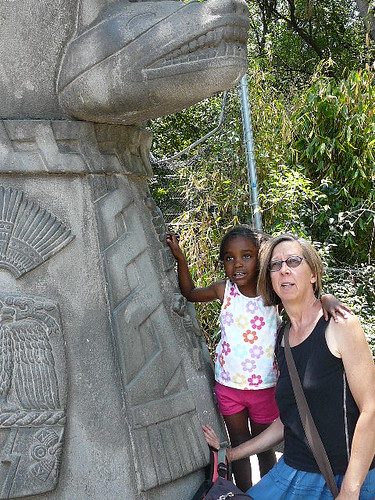
Not so nice here at the moment. We need the rain, but the gray weather's a bummer.
While I would give anything to have her back, and hear that that feeling subsides little as the years go by, I know that we will always be a table with three legs. As time goes by, you learn to put the heavy stuff on one corner and just where to place the chairs in case things topple, but these gymnastics only serve to remind you of what you lost.I was already thinking about Maggie and my brother's family a lot these last few weeks, so I wanted to both share the Shreveport Times story with y'all and publicly express my admiration for Jinny, John, and their son Jack. They each have weathered this terrible storm with remarkable courage and dignity, transforming grief into literally a constructive force. I couldn't be more proud of them for it.
Then again, at least I have a three-legged table while some people have no table at all. I am vastly aware of what I have left. August 2nd marks the one year anniversary of 6 Shreveport teenagers drowned while swimming, one mother losing three children on the same day. That is a pain I cannot fathom.
As we begin our third year of life without Maggie Lee, I have to be thankful for God’s sustaining grace, a loving family and the most unshakable friends in the world.
Last summer the Austin Water Utility projected a five-year total increase in residential water rates of 30 percent. ... Recently the Water Utility released its initial budget figures. Councilmember Bill Spelman has analyzed the data - and calculated a projected 5-year water rate increase for residential customers of 66%. Go to http://www.billspelman.org/2011/05/spelman-analyzes-projected-5-year-water-bill-increases/ and click on the "spreadsheets here" link and look at the "monthly bill" chart.
That is an eye-popping sixty-six percent rate increase - and more than double the Water Utility's projection from just last year. And it follows seven years of annual rate increases. (If you just count last year's increase, the six year increase thru 2016 is projected at 74 percent.)In that context, please recall that last year's SOS Alliance report on this very topic (attached, titled "The Perfect Storm") predicted - wait for it - a 74% residential water rate increase over six years from publicly available data ! I remind you of this to ensure that, if and when you report on the subject, you make it clear to your readers and/or viewers that these rate hikes were not a surprise. Don't, in your coverage, allow the Mayor, Greg Meszaros, Daryl Slusher, etc., to greet Spelman's calculations in your stories with quotes saying "We couldn't have known." They could, and they did. But they wanted to keep this fact out of the public debate until WTP4 bonds were issued, construction began and it was too late to do anything about it.

The question you ask is a good one. While I am not a scientist, but as a long suffering, pestering enthusiast I can offer up anecdotal evidence.I appreciate the author's response, and he's probably right nobody knows. I'm still curious about it, though.
The most obvious demographic quirk I've noticed about illusions is age. The young quickly realize almost all illusions with no trouble at all. They seem to walk into them guileless. The older a witness is the harder it becomes. You don't see that many optical illusion shows in Florida.
As for After-image illusions. My own research has turned up several factors which affect the ability to "see" them; such as heredity, eye color, color blindness, and a host of other vision problems, including bad lighting. I have never found a definitive answer and suspect that nobody really knows. Perhaps you were born with an extra supply of photo chemicals, and just don't run dry that easily. Perhaps your eyes have an Indianapolis 500 Pit Crew and the photoreceptors are replenishing too quickly. Perhaps your eyes are making tiny movements which are undetectable, thus making it difficult to expose a single patch of neurons to the illusion. Perhaps you are an alien plant, and have just inadvertently given humans a sure fire test to discover and weed out your kind.
As an artist who draws illusions for a living I can tell you that it is possible to oversaturate oneself with an illusion. Most illusions do not stop working while I draw them, and with some illusions it can be like trying to paint a leaf while it's falling; as things tend to wander out from under my eyeballs. But with some illusions I can become burnt out; I just can’t see them easily anymore. I run the risk of ruining the illusion, making it too obvious by far in order to stimulate my own burnt out senses. The reason for this phenomenon may be that we are human; we learn. The brain adapts. Just as the brain can make your nose invisible to both eyes, it can make an illusion invisible, once it figures out you don't really need to "see" it. Perhaps you are just more adaptable than the rest of us.
The images in our mind are extraordinarily rich. We can tell if something is liquid or solid, heavy or light, dead or alive. But the information we work from is poor - a distorted, two-dimensional transmission with entire spots missing. So the mind fills in most of the picture. You can get a sense of this from brain anatomy studies. If visual sensations were primarily received rather than constructed by the brain, you'd expect that most of the fibres going to the brain's primary visual cortex would come from the retina. Instead, scientists have found that only twenty percent do; eighty percent come downward from regions of the brain governing functions like memory. Richard Gregory, a prominent British neuropsychologist, estimates that visual perception is more than ninety percent memory and less than ten percent sensory nerve signals.So memory is filling in most of the image you see when you "see" something, which is why eyewitness errors are much more likely when identifying strangers. As for the optical illusion: No wonder most people see afterimages if our memory is generating 80-90% of our visual perception. Your brain is busy filling in all the gaps in the image you're looking at, and when it's taken away it can't immediately shut down that extraordinarily complicated function. Who knows why I'm an exception, but there always is one. I'd still like to know.
Texas soon will be shelling out more per year to pay back money it borrowed for road construction than it spends from its quickly vanishing pile of cash to build new highways.The whole story is worth a read. That makes me mad because state government - especially Texas - supposedly pays as it goes, as opposed to the federal government which has run up a $1.5 Trillion annual deficit. We're not supposed to be borrowing for our entire damn road budget! The feds do that. "Oh, let's have a couple of wars and put it all on the credit cards." But state government at a fundamental level shouldn't be operating that way. Apparently the bonds we're currently operating from were issued in 2007 and we'll completely run out of road money by next year. Genius. (/sarcasm)
Legislative leaders characterize the state's transportation funding as a crisis. Most Texans, they say, are unaware of its severity and must be educated before the state can find new ways to finance new roads.
The gasoline tax pays for road maintenance and construction but has not increased in 20 years. Gas tax revenue peaked in 2008 and likely will decline as vehicles become more fuel-efficient.
"It's not a crisis until everybody agrees that it's a crisis. Right now, people who don't understand it are saying, 'You're crying wolf,'" said House Transportation Committee Chairman Joe Pickett, D-El Paso. "Yes, it's a crisis."
Senate Transportation and Homeland Security Committee Chairman Tommy Williams, R-The Woodlands, agrees.
"The gravity of the situation is that in the absence of further action by the Legislature this session, we will literally be out of money for new construction in 2012 in the fastest-growing state in the country and in one of the largest states in the country," he said. "We need to begin to have a discussion about it."


